
Comfrey in Topical Skincare: Uses, Science, Safety & History

🌿 Introduction: Why Comfrey Still Matters in Skincare
Comfrey (Symphytum officinale) is one of the most historically significant herbs used in topical care. Known for centuries by names like knitbone and boneset, comfrey earned its reputation through repeated use on bruises, sprains, wounds, and musculoskeletal injuries.
Today, consumers are increasingly curious about why comfrey was used, what modern science says, and how it fits responsibly into contemporary skincare. This guide explores comfrey from an educational lens — blending history, peer-reviewed research, and modern safety understanding — without marketing or product claims.
🌱 What Is Comfrey (Symphytum officinale)?
Comfrey is a fast-growing perennial herb native to Europe and Western Asia, now naturalized in many parts of the world. It features large, fuzzy leaves and drooping purple or cream-colored bell-shaped flowers.
Historically, both the leaves and roots were used in topical preparations such as:
-
Poultices
-
Compresses
-
Oils
-
Salves and ointments
These preparations were applied externally to the skin, often over areas of trauma or irritation.
🕰️ A Brief History of Comfrey in Topical Use
Comfrey’s documented use dates back more than 2,000 years. Ancient Greek physicians, including Dioscorides, described its external use for wounds and inflammation. In medieval Europe, comfrey was a staple herb in monastery gardens, valued for its role in treating injuries sustained during labor or travel.
The name knitbone reflects repeated observations: when applied externally, comfrey preparations appeared to support faster recovery of injured tissues, particularly those surrounding bones and joints.
While traditional use alone is not proof, it guided modern researchers toward studying comfrey’s chemical composition and biological activity.
🧪 Key Compounds in Comfrey That Matter for Skin
Allantoin: Tissue Renewal Support
Comfrey is one of the richest botanical sources of allantoin, a compound still used today in dermatology.
Allantoin is known to:
-
Support cell proliferation
-
Encourage granulation tissue formation
-
Promote skin regeneration
-
Improve smoothness and barrier recovery
📚 Staiger, C. (2012), Phytotherapy Research
https://doi.org/10.1002/ptr.4592
Allantoin helps explain why comfrey was traditionally associated with visible improvements in damaged or irritated skin.
Rosmarinic Acid: Inflammation Modulation
Comfrey also contains rosmarinic acid, a polyphenol studied for its:
-
Anti-inflammatory activity
-
Antioxidant capacity
-
Role in modulating inflammatory mediators
Inflammation is a key factor in skin irritation, bruising, and connective tissue stress.
📚 Petersen & Simmonds (2003), Journal of Pharmacy and Pharmacology
https://doi.org/10.1211/002235702760345204
Mucopolysaccharides & Tannins
Additional constituents contribute to:
-
Skin hydration
-
Tissue resilience
-
Temporary tightening effects
-
Protective surface feel
These compounds support comfrey’s traditional role in topical comfort and structural support rather than internal healing.
🦴 Comfrey and Bone-Related Recovery: What Research Shows
Comfrey does not regenerate bone tissue when applied topically. However, scientific research shows that it may support soft tissue recovery around bones, which historically contributed to its reputation.
Clinical Studies on Musculoskeletal Conditions
-
Acute back pain: Significant pain reduction within 5 days
-
Ankle sprains & contusions: Reduced swelling and improved mobility
📚 Grube et al. (2007), British Journal of Sports Medicine
https://bjsm.bmj.com/content/41/9/605
📚 Koll et al. (2004), Phytomedicine
https://doi.org/10.1016/j.phymed.2004.02.001
These findings suggest comfrey may create a supportive environment for recovery in surrounding tissues, which historically aligned with fracture care practices.
🌿 Frankincense and Comfrey: A Traditional Pairing
Frankincense (Boswellia species) has been used alongside comfrey in traditional topical preparations.
Frankincense contributes:
-
Anti-inflammatory compounds (boswellic acids)
-
Antioxidant activity
-
A grounding, resinous aromatic profile
📚 Neal’s Yard Remedies – Frankincense Research Overview
https://www.nealsyardremedies.com/blogs/news/frankincense-the-ancient-remedy
Modern studies suggest frankincense may support wound healing pathways and inflammation modulation when used topically.
📚 MDPI Pharmaceuticals (2025)
https://www.mdpi.com/1424-8247/18/2/248
🧴 How Comfrey Is Used in Modern Skincare
Today, comfrey is typically found in:
-
Herbal salves
-
Botanical balms
-
Creams and ointments
-
Infused oils
Modern formulations emphasize:
-
External use only
-
Controlled extraction
-
Short-term application
-
PA-reduced or filtered preparations
These approaches align with both scientific evidence and regulatory guidance.
⚠️ Safety & Regulatory Considerations
Pyrrolizidine Alkaloids (PAs)
Comfrey naturally contains pyrrolizidine alkaloids, which can be hepatotoxic if ingested or absorbed in large amounts.
Current scientific and regulatory consensus states:
-
❌ Internal use is contraindicated
-
✔ External use may be acceptable when limited and responsible
-
✔ Avoid use on broken skin
-
✔ Short-term topical use is emphasized
📚 European Medicines Agency – Assessment Report on Symphytum officinale
https://www.ema.europa.eu
🌍 Modern Interpretation of Comfrey in Skincare
From an evidence-based perspective, comfrey is best understood as a topical botanical that supports the skin’s natural repair processes, particularly in:
-
Connective tissue
-
Bruised or stressed skin
-
Areas surrounding joints and bones
-
Dry or compromised skin barriers
Its historical reputation reflects observable outcomes, now supported by biochemical and clinical insights.
✅ Key Takeaways
-
Comfrey has centuries of documented topical use
-
Allantoin plays a central role in skin regeneration
-
Clinical studies support musculoskeletal comfort
-
It supports recovery around bones, not bone fusion
-
Safe use requires external, limited application
Learn More
Allantoin in Comfrey: Why It Matters for Skin Regeneration
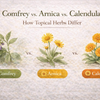
Comfrey VS. Arnica VS. Calendula: How Topical Herbs Differs
Why Jojoba Oil in Botanical Skincare?
📚 References
-
Staiger, C. (2012). Comfrey: A clinical overview. Phytotherapy Research
https://doi.org/10.1002/ptr.4592 -
Grube, B. et al. (2007). Efficacy of comfrey root ointment for acute back pain. British Journal of Sports Medicine
https://bjsm.bmj.com/content/41/9/605 -
Koll, R. et al. (2004). Topical comfrey for ankle sprains. Phytomedicine
https://doi.org/10.1016/j.phymed.2004.02.001 -
Petersen, M., & Simmonds, M. (2003). Rosmarinic acid. Journal of Pharmacy and Pharmacology
https://doi.org/10.1211/002235702760345204 -
European Medicines Agency. Assessment Report on Symphytum officinale
https://www.ema.europa.eu
- Posted in allantoin, botanical salves, comfrey, comfrey skincare, frankincense, herbal safety, herbal skincare education, plant-based skincare, topical botanicals, traditional herbs